
Pain stories from the clinical perspective of Goyang Team Doctor Orthopedic Clinic

Hello, this is Goyang Team Doctor Orthopedic Clinic.
Have you ever had to set your coffee cup down in the morning because of a sharp twinge on the outside of your elbow? It often seems to settle after a few days of rest, only to flare up in the same spot the moment you pick up a racket or lift a shopping bag.
If you are looking for an orthopedic clinic in Haengsin-dong, today we want to look at tennis elbow through one question: “When is it okay to use the arm again?”
The formal name for tennis elbow is lateral epicondylitis. The tendons of the forearm muscles that extend the wrist and fingers attach to the bony point on the outside of the elbow, and pain develops as repeated strain builds up at this attachment.
Although tennis is in the name, it is not limited to people who play racket sports. It can also come from turning screws, lifting heavy objects, or housework and jobs that involve frequently bending the wrist back.
Rather than coming from a single major injury, it is closer to an overuse injury in which small loads accumulate over a long time. That is why it is often hard to pinpoint exactly when the pain started. This type of injury typically hurts with movement and settles with rest. Swelling is usually minimal or mild.
This is exactly where the problem lies. Because it hurts less with rest, it is easy to feel that it has healed, but a decrease in pain and a tendon that is ready to bear load again are not necessarily the same thing.
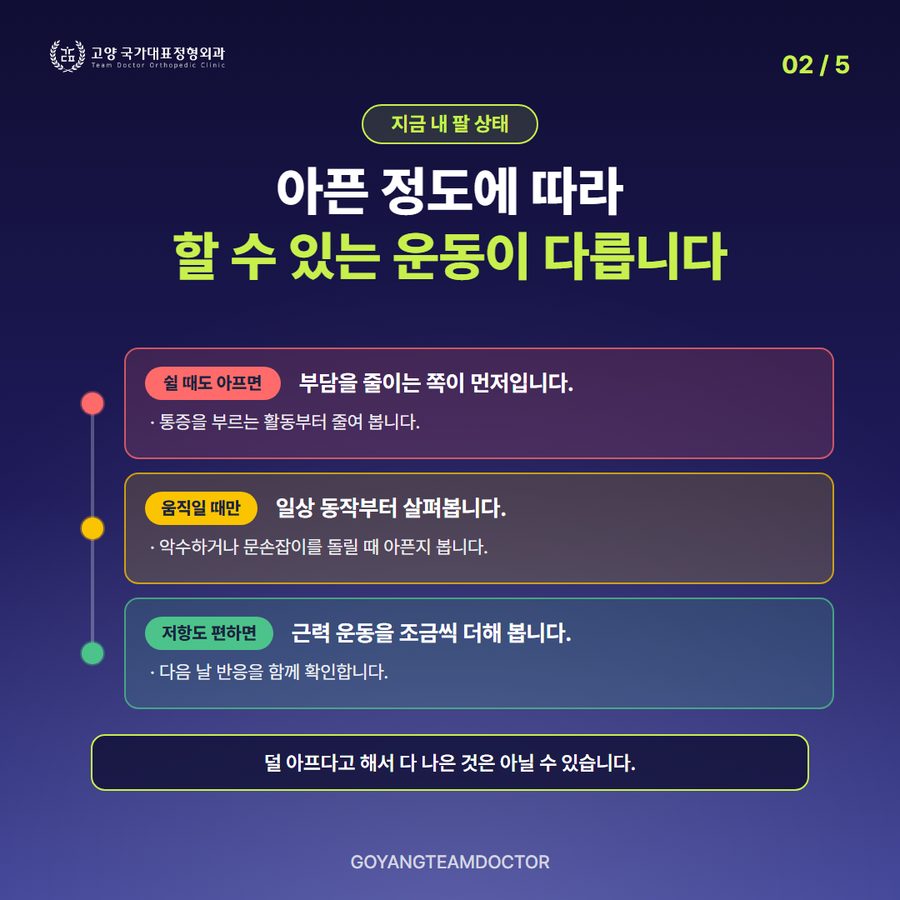
So when thinking about returning, it can be more important to ask “What stage am I at?” before “Does it hurt right now?” The stage where it hurts even at rest, the stage where it hurts only with movement, and the stage where it tolerates light resistance each call for different exercises.
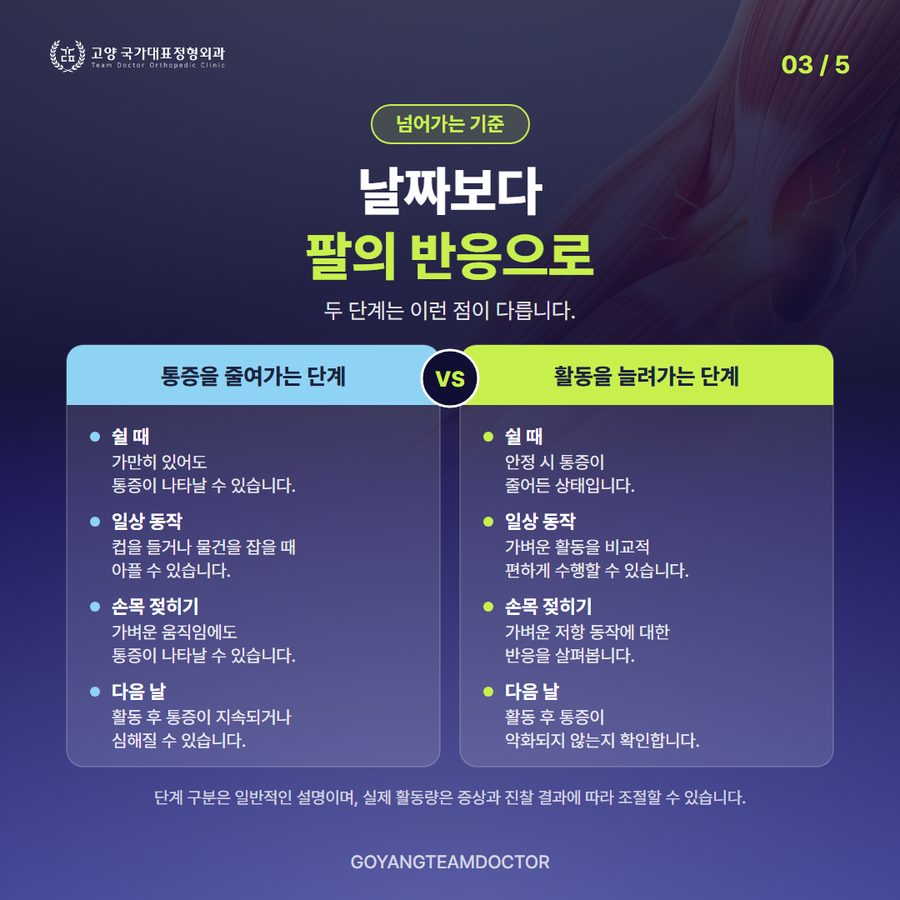
The criterion for moving to the next stage is closer to how the arm responds than to the calendar. Which movements hurt, and how much, tells us more than how many weeks have passed.
The first thing we look at is pain at rest. If it throbs even when you are still, it may still be time to focus on reducing the load.
Next come everyday movements. We check whether the outside of the elbow hurts when shaking hands, turning a doorknob, or lifting an object with the palm facing down. Once these movements feel comfortable and light resistance does not cause much pain, strength exercises can be added little by little from that point.
Here is how the pain-reduction stage and the activity-building stage compare side by side.
| Category | Pain-reduction stage | Activity-building stage |
|---|---|---|
| At rest | Pain may be present even when you are still. | Pain at rest may be reduced or nearly gone. |
| Everyday movements | Pain may occur when lifting a cup or gripping objects. | Light everyday movements can be performed fairly comfortably. |
| Wrist extension | Pain may occur even with light movement or resistance. | We monitor pain and changes in function during light resistance movements. |
| Exercise direction | Activity level and exercise load are adjusted based on the pain response. | Loads such as strength exercises are increased gradually depending on your condition. |
| The next day | Pain may persist or worsen after activity. | We check that pain after activity is no worse than before. |
Rather than deciding from any single row, it is better to look at several rows together to gauge where you are now. Even with the same pain, the pace at which the load can be increased varies from person to person depending on age, occupation, and type of sport.
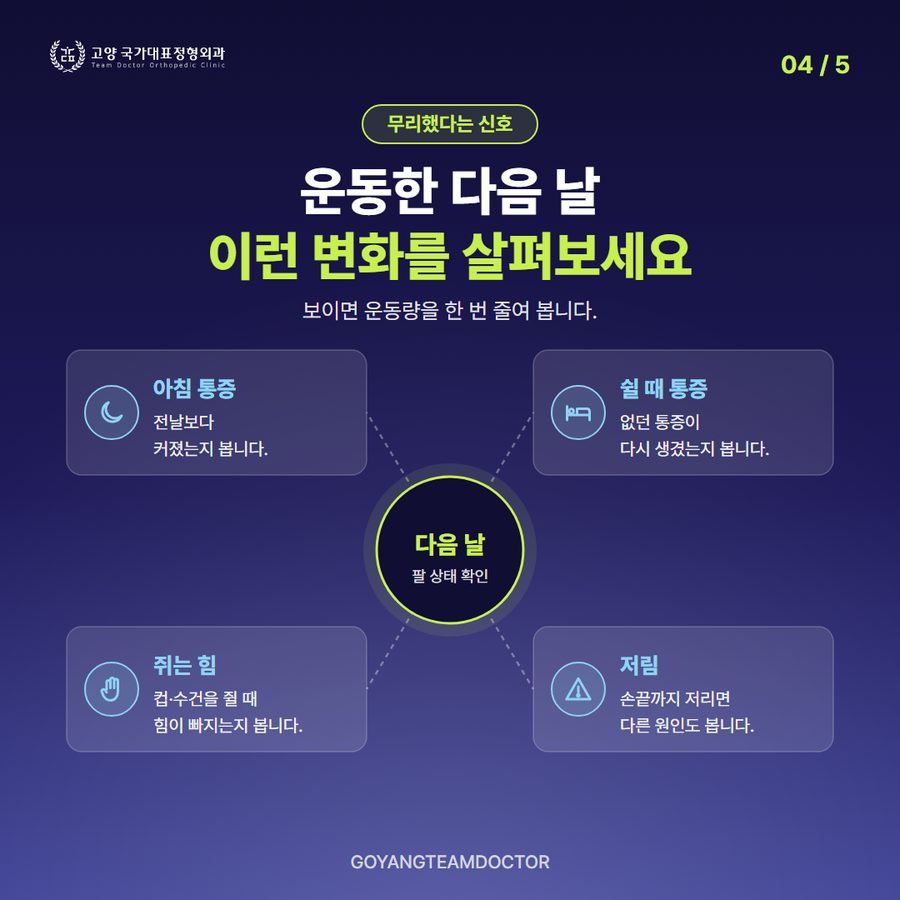
When building exercise back up, what is missed most often is not what happens during the workout but the day after. A tendon may hold up during exercise and then react a few hours later or the next morning. So if you raise the intensity right away because it felt fine during the session, you can find yourself back at square one a few days later.
By the time people are looking up an orthopedic clinic in Haengsin-dong, many have already been through this cycle several times. If you notice the signs below, you can step back one stage.
These include pain on the outside of the elbow that is worse the next morning than the day before, pain at rest that returns after having been gone for a while, or a feeling of weakness when gripping a cup or a towel.
During the consultation, we look at these changes together. We ask when the pain first started and which movements hurt, and we check the response when the most painful spot is pressed, pain when the wrist is extended against resistance, and any difference in strength between the two sides.
Not every pain on the outside of the elbow is tennis elbow. If tingling runs all the way to the fingertips or the pain also comes with neck movement, other causes need to be considered as well. Imaging is considered when needed based on symptoms and examination findings. Ultrasound can be used to look at soft tissues such as tendons.
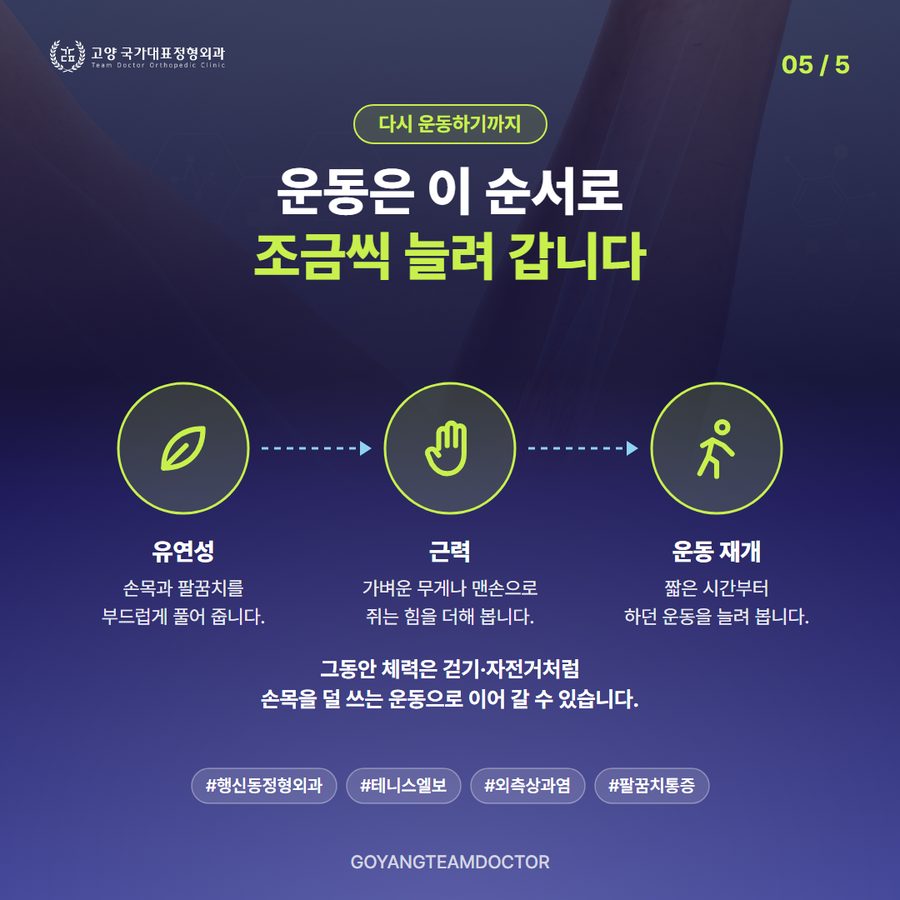
The criteria for returning differ from person to person. Someone who wants to play tennis for an hour on the weekend and someone who moves heavy loads every day need different levels of strength in the elbow.
So we work backward from the target activity: how much wrist-extension strength that activity requires, how many times it is repeated, and how far along your arm is toward handling that load right now.
Once the pain has eased, people often start with flexibility exercises for the wrist and elbow and move on to strength exercises using light weights or body weight alone. Gripping movements, such as wringing out a towel, can also be added gradually. In the meantime, you can maintain your fitness with activities that use the wrist less, such as walking or cycling.
When returning to racket sports, it is also worth checking for a habit of snapping the wrist on contact and the condition of your racket.
Does it hurt at rest? Are everyday movements comfortable? How does it respond the next day? What is still left before your target activity? If your elbow pain has been dragging on while you look for an orthopedic clinic in Haengsin-dong, writing down these four things first can help you gauge what stage you are at now.